
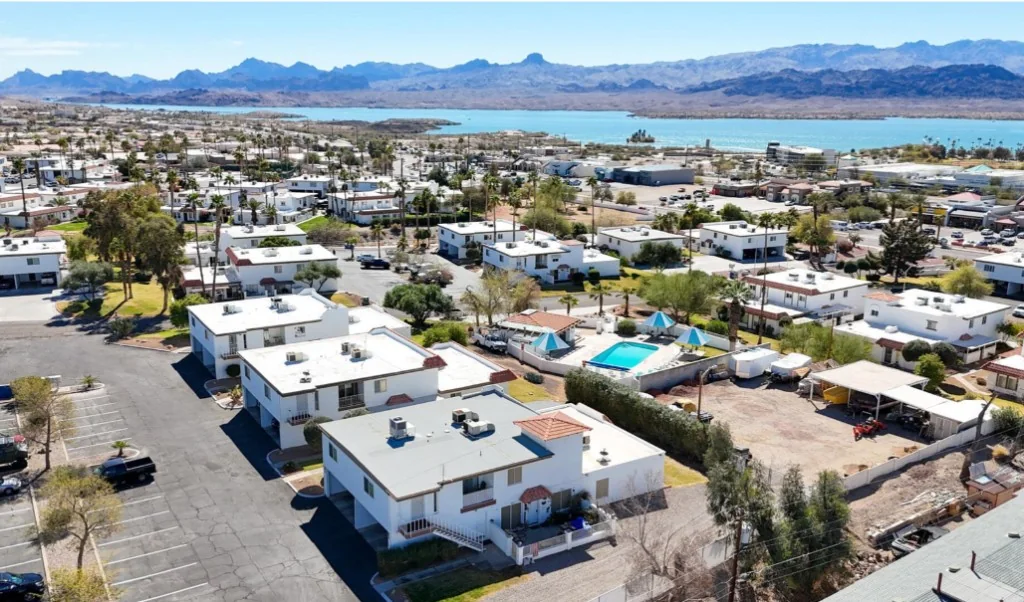
Measure the equipment and the full route into the space. Confirm parking rights and restrictions in writing before relying on a listing’s garage or boat-parking description.
Identify exactly which space comes with the unit
An enclosed garage, a covered carport and an assigned open space solve different problems. Ask which space is included with the purchase and what document establishes the arrangement. Also ask whether a storage room or additional space has a separate cost or agreement.
Walk to the space from the unit. Note the lighting, the carrying distance, the door access and any steps. If two adults will keep vehicles in Havasu, check the second space as carefully as the first.
| Space | What to confirm |
|---|---|
| Enclosed garage | Clear opening, usable depth, interior obstructions and the right to use the space. |
| Carport or assigned space | Space identification, assignment terms, clearance and vehicle restrictions. |
| Guest parking | Where guests may park, any time limit and how busy periods are handled. |
| Boat or trailer area | Whether the exact equipment is allowed, availability, access and any separate arrangement. |
Measure clearance instead of counting garage spaces
Record your vehicle or boat’s full dimensions in travel configuration. For a trailer, include the tongue, coupler and anything extending behind the hull. Record the actual height of the tallest fixed item. Then measure the garage door’s clear opening and the usable inside space.
Cabinets, water heaters, steps and door hardware can reduce usable depth or width. The approach matters too: check the turn from the drive aisle, the slope, gate clearance and room to straighten the trailer. A broad two-car description is not a fit test.
- Clear opening width and height with the door fully raised.
- Usable depth to the nearest obstruction, not only wall-to-wall length.
- Room for doors, walking space and any regular storage.
- Turning room and access at the time you expect to arrive.
Treat boat storage and lake access as separate decisions
Being close to the water does not mean a condo has room for a trailer. Ask about overnight parking, loading and unloading, temporary staging and any shared storage area. Check availability as well as permission; a permitted use is not always an available space.
Plan the route from the condo or storage location to the launch ramp you expect to use. Account for where equipment stays between trips. If off-site storage is part of the plan, get a current quote and confirm that the space can accommodate your setup before relying on it.
Plan for guests, deliveries and the next vehicle
A parking arrangement that works for your everyday car may be less convenient when guests arrive or you bring a larger vehicle. Ask how guest permits, deliveries and oversized vehicles are handled. Include charging needs if relevant, and request the association’s process before assuming equipment can be installed.
Take photographs and measurements during the tour, then keep the current parking rules with the property notes. If a required space is unavailable or cannot fit the equipment, resolve that before spending time on interior details that will not solve the underlying problem.
Questions that come up
Do Lake Havasu condos have RV garages?
Some listings may have larger garages or special parking arrangements, but verify the exact unit and space. RV or boat fit depends on clear dimensions, the approach and association restrictions. A garage-space count does not establish clearance.
Check current condo listing detailsCan I park a boat trailer in the condo parking lot?
Ask the association about the exact trailer and intended duration. Shared parking may have vehicle, location or time restrictions. Confirm permission and available space before counting on overnight storage.
Check the applicable parking rules